The reinforcement hoop that wraps the longitudinal bars in columns and beams and carries shear. The quiet hero of seismic safety.
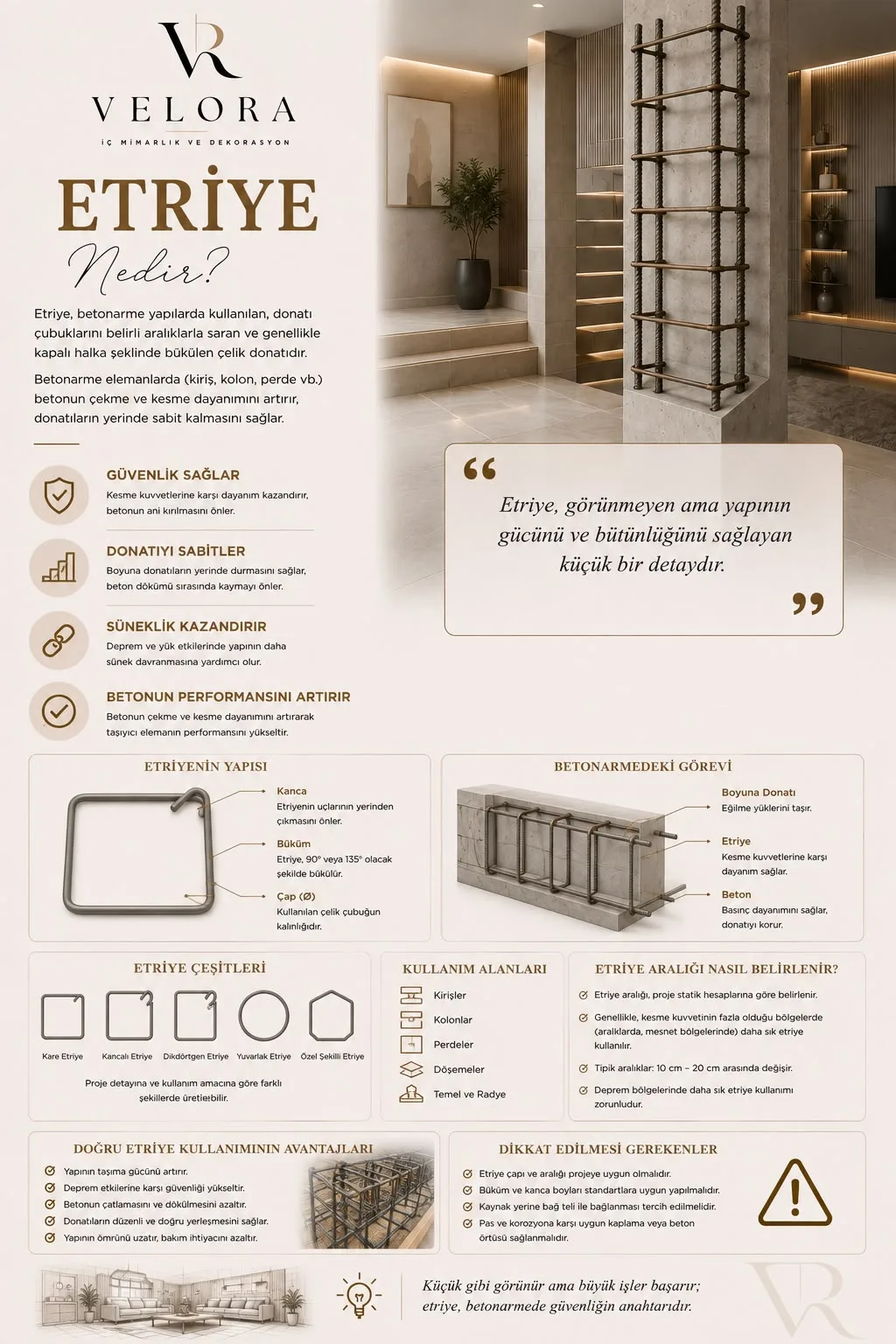
A stirrup is the closed reinforcement hoop placed at intervals around the longitudinal bars of reinforced concrete columns, beams and walls. It carries shear, prevents the main bars from buckling and confines the concrete core.
What stirrups do
- Shear strength: they carry the shear produced by lateral loads such as earthquake and wind.
- Confinement: wrapping the core raises its compressive strength and ductility.
- Anti-buckling: they stop the longitudinal bars from splaying outwards under load.
- Bar position: they hold the main bars in their designed places.
Types
- Square: the most common form, for square columns.
- Rectangular: for rectangular columns and beams.
- Circular / spiral: continuous confinement for round columns.
- Cross ties: extra links inside the stirrup that restrain intermediate bars in wide sections.
Hook and bend rules
- Seismic codes require the ends to be bent with a 135° hook; a 90° hook opens up once the concrete spalls.
- The hook extension must be at least ten bar diameters.
- Bend radius follows the bar diameter — a sharp bend cracks the steel.
The confinement zone
Spacing is reduced at the ends of columns and beams, near the joints. What is 15–20 cm along the body drops to 10 cm or less in the confinement zone. A large share of earthquake damage traces back to missing or widely spaced stirrups exactly here.
Points to watch
- Never open the spacing beyond what the drawings state.
- Stagger the hooks instead of aligning them all on one face.
- Do not use rusted or damaged, previously bent bar.
- Use plastic spacers so the cover to the stirrup is maintained.
Tagsbetonarmedonatıdeprem